Freezing Cherries from A to Z: How the Tevitta Factory Works

Journalists from Kurkul.com were lucky to visit the Tevitta frozen product factory, equipped with modern equipment. It is here, in the town of Shpola in the Cherkasy region, that high-quality fruits and berries are produced using the shock freezing technology. Thanks to the chosen technology, the products retain all their beneficial properties. So, how does it all work? We were told by Valentyna Hulina, the Head of the Standardization Department. Together with her, we learned about all stages of sorting, inspection, and the freezing process itself.
Receiving, Inspection, and Sorting
The first point through which the raw materials pass, which will later be frozen, is the receiving ramp. Here, after unloading from trucks, the raw materials are weighed and sorted. The next stage is the pre-cooling chamber, where batches accumulate. After that, the raw materials wait for their turn for processing.
“Initially, the product enters the production area. For example, explaining the processing of cherries without stems. At the first stage, the stem removal is skipped, and the raw material is immediately washed. After this, the cherries proceed to the first stage of inspection,” says Valentyna Hulina.
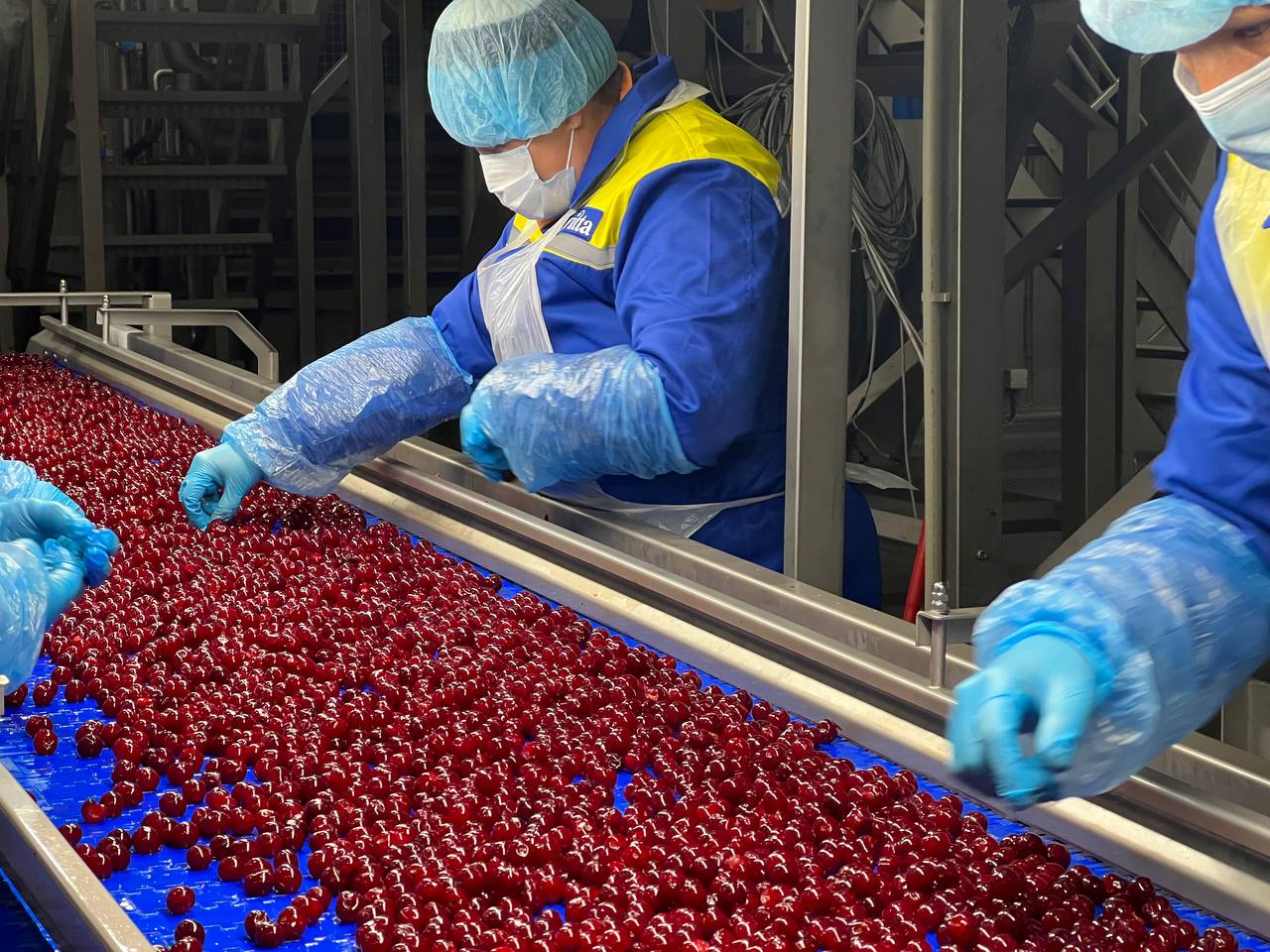
According to her, during this process, two factory workers select rotten or under-ripe fruits, remove any remaining stems, leaves, and other debris.
“The level of contamination depends on the method of harvesting cherries. If, for example, the fruits were hand-picked, almost all of them will be without stems. When harvested by a combine, the contamination percentage is higher,” explains the Head of Standardization.
Calibrating, Pit Removal, and Freezing
Meanwhile, factory workers continue selecting under-ripe or rotten fruits, and the work continues in full swing. After cleaning, the raw materials are sent for calibration, where they are sorted into three sizes. Two of these sizes are sent for the pit removal stage, while cherries up to 20 mm in size are placed in boxes and sent for freezing with pits intact. Cherries with pits are used for compote production.
“Here, we are at the calibration stage, where we see the raw materials being sorted into three sizes. This is done to efficiently remove the pit from the cherry. As a result, the medium and large calibers are sent to the pit removal machines. The smallest caliber is frozen for compote mixes,” comments Valentyna Hulina on the process.
Sorting cherries of different sizes is necessary to better remove the pits. The machines are equipped with matrices of different sizes; if a smaller cherry is placed into a larger matrix, it will be completely crushed. Conversely, if a larger cherry enters a smaller matrix, the pit will not be removed and will remain in the cherry.
«We calibrate the cherries to ensure effective pit removal. After that, the cherries move on conveyors to the pit-removal machines, where they are evenly distributed onto matrices using a distribution tray. After the pits are removed, the pitted cherries move onto the conveyor, while the pits are sent via a screw conveyor to a machine that separates the puree from the pits,” explains the Head of Standardization.
This year, the factory plans to try using cherry pits as fuel. Since the pit makes up 10-12% of the cherry’s weight, the larger the fruit, the larger the pit.
“After the pits are removed, the fruits proceed to the raw material inspection stage, the last one before freezing in the tunnel. Here, workers remove any leftover pits, as well as any remaining stems or leaves that might have been missed during the first inspection. The cherries themselves are also given a final check,” says Valentyna Hulina.
The final stage before freezing is passing through a vibrating table, where any remaining moisture is removed. After that, the cherries are frozen in the tunnel.
“Each product has its own freezing temperature, and accordingly, the time each berry spends in the tunnel differs. For example, blueberries require much less time than cherries because the berries differ in size,” explains the expert.
Cherries stay in the tunnel for approximately 10-12 minutes, with an operator monitoring them the entire time. The cherries exit the tunnel at a temperature no higher than minus 22°C. After freezing, the final stage of sorting takes place — the final inspection.
During the last inspection, the finished product is examined. Mechanically damaged or deformed fruits are selected out. After that, the cherries move to special equipment — a weight dispenser, where a specific volume is formed for packaging.
Final Stage: Packaging and Distribution
All the berries are packaged into boxes. This takes place on a weight dispenser, where the raw material is weighed and monitored. When the required amount of raw material is loaded, the sensor activates, and the machine transfers the product into the box. The boxes are formed in 10 kg increments, but each one is checked through a final weight measurement. If the weight is correct, the box moves on; if not, the operator adjusts the weight. After that, the boxes are sealed, scanned on a metal detector, stacked onto pallets, labeled, and sent to the warehouse for storage. The shelf life of the frozen product is maintained.
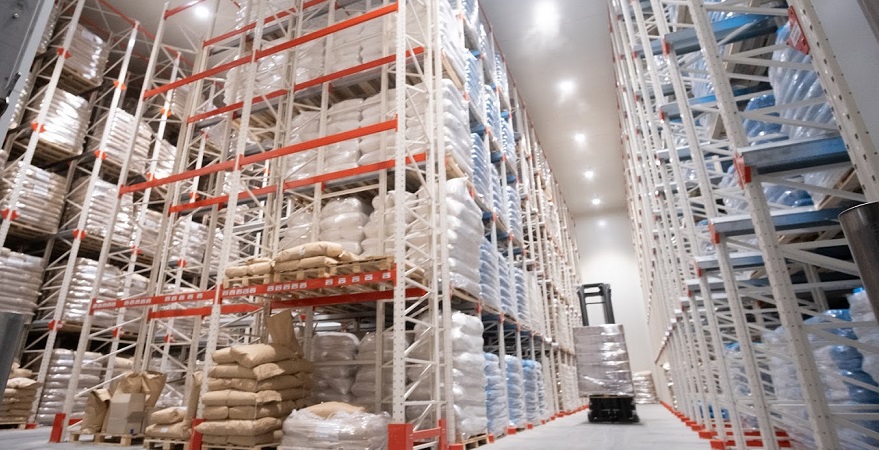
Additionally, all finished products are stored in warehouses with a temperature of minus 18°C and a capacity of over 10,000 pallet spaces. The factory’s convenient location allows for the delivery of raw materials for freezing from both the western and southern regions of Ukraine.